


Australia’s First Multi-Storey 3D Printed Home Built with AI Technology
A multi-storey, liveable home in suburbia printed with AI-powered 3D construction technology will be the first of its kind in the southern hemisphere, with every aspect of the project home-grown in Sydney and Melbourne.
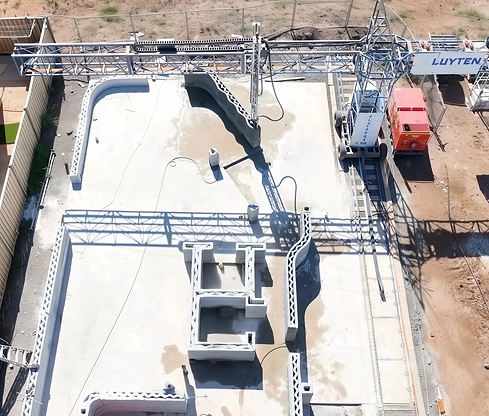
MELBOURNE, Australia, Feb. 11, 2025: In Melbourne's outer suburbs, a giant robotic crane 3D printer towers over a concrete house being built.
The robotic crane 3D printer is an unusual sight in a quiet residential street in Melbourne, Victoria.
But it's no ordinary crane, it's LUYTEN's cutting-edge PLATYPUS X12 Crane 3D Construction Printer. It is AI-powered and is making history by 3D home printing the first multi-storey house in Australia and the Southern Hemisphere.
Printing a Multi-Storey Home in Extreme Melbourne Conditions
While previous attempts of using this technology were limited to single-storey, standard home prototypes printed in 20–24 degrees Celsius weather conditions, this house started printing during a Melbourne summer in 35–42 degrees Celsius heat and frequent storms.
This was not a controlled laboratory environment. It was a real suburban site, exposed to heat, wind shifts, and changing humidity. Printing continued despite these variables, demonstrating that large-scale 3D concrete construction can operate beyond ideal weather windows.

Design Innovation: Lift Core and Acoustic Geometry
The house design was optimised to introduce features to push 3D printing potential to the limit, such as printing a lift core and walls with shapes that serve as noise cancelling using the acoustic principle of diffraction.
Printing a lift core as part of the structural build marks a significant milestone for multi-storey 3D printed housing. The geometric wall formations are not decorative. They are functional, engineered forms that contribute to both structural integrity and internal comfort.
How the AI-Powered 3D Construction Printer Works
The AI-powered printer uses reinforcement learning algorithms to help ensure the quality of each layer of the print because the concrete layers are not just about aesthetics, it is structural and the AI software ensures precision construction.
Each layer is deposited with structural intent. Unlike conventional formwork and concrete pouring methods, the process builds the load-bearing system layer by layer with digital control guiding placement accuracy.
The PLATYPUS X12 Crane 3D Construction Printer enables multi-storey capability by combining crane-scale reach with controlled material deposition.
A CEO Living in the 3D Printed Home
The multi-story, 350 m2 home will be lived in by Ahmed Mahil, the CEO and Global President of LUYTEN.
"As the first CEO to live in a 3D printed house, printed by his own company and his company's manufactured robots, I intend to break the psychological barrier people may have and to smash any doubts in the industry about the future of 3D printed homes," said Mr Mahil.
The decision to occupy the home signals confidence in the structure, durability, and long-term performance of 3D printed residential construction.

From 8–11 Months to 5 Weeks: Construction Speed Comparison
3D printing can help deliver faster homes. LUYTEN's multi-storey home is expected to be finished in 5 weeks, compared to the usual 8–11 months for a build.
The reduced build time is not just about speed. It directly impacts labour exposure, material logistics, and project turnover for developers.
The 3D concrete printing technology enables:
-
60 per cent reduction of construction waste
-
70 per cent reduction of production time
-
80 per cent reduction of labour costs
When compared to hands-on construction projects, this represents a measurable shift in how residential builds can be delivered.
How the AI-Powered 3D Construction Printer Works
The AI-powered printer uses reinforcement learning algorithms to help ensure the quality of each layer of the print because the concrete layers are not just about aesthetics, it is structural and the AI software ensures precision construction.
Each layer is deposited with structural intent. Unlike conventional formwork and concrete pouring methods, the process builds the load-bearing system layer by layer with digital control guiding placement accuracy.
The PLATYPUS X12 Crane 3D Construction Printer enables multi-storey capability by combining crane-scale reach with controlled material deposition.
A CEO Living in the 3D Printed Home
The multi-story, 350 m2 home will be lived in by Ahmed Mahil, the CEO and Global President of LUYTEN.
"As the first CEO to live in a 3D printed house, printed by his own company and his company's manufactured robots, I intend to break the psychological barrier people may have and to smash any doubts in the industry about the future of 3D printed homes," said Mr Mahil.
The decision to occupy the home signals confidence in the structure, durability, and long-term performance of 3D printed residential construction.
Addressing Australia’s Housing Supply Challenges
3D printing is emerging as an innovative solution to Australia's housing crisis, and it's capturing the attention of the Federal and State governments.
With labour shortages and extended build timelines impacting housing supply, alternative construction methods are being explored across the country.
"We've had positive feedback and support from State and Federal governments, and late last year we had the Minister for Industry and Science, Hon Ed Husic, visit our 3D construction printer robot factory in Melbourne," said Mr Mahil.
Government interest reflects recognition that faster construction cycles may contribute to increased housing availability.
Structural Certification and Engineering Validation
LUYTEN are also proud to be working alongside renowned international engineering firm Bollinger + Grohmann on the certification of the groundbreaking home, ensuring structural integrity, safety, and optimal performance of the printed structure.
The certification process validates load-bearing performance, compliance, and engineering reliability.
LUYTEN is also collaborating with the University of New South Wales ARC Centre for Next-Gen Architectural Manufacturing's research and design expertise for the design of the home.
By combining engineering assessment with academic research input, the project integrates structural validation with architectural experimentation.
What Makes This Multi-Storey 3D Printed Home Historic
This project represents:
-
The first liveable multi-storey 3D printed home in Australia
-
The first of its kind in the Southern Hemisphere
-
A structure printed in extreme 35–42°C summer heat
-
AI-driven structural layer verification
-
Lift core printed as part of the structural system
-
Acoustic wall geometry integration
-
CEO occupancy demonstrating real-world confidence
Unlike previous single-storey prototypes globally, this is a fully liveable suburban residence built under real environmental conditions.

Why This Project Matters for the Future of Construction
This project demonstrates that multi-storey 3D printed housing is viable in standard suburban environments.
It shows that 3D concrete printing can:
-
Operate in high-temperature conditions
-
Produce structural multi-level residential buildings
-
Reduce construction timelines significantly
-
Lower material waste
-
Function within regulatory and certification frameworks
It moves 3D printed construction beyond prototype stages and into liveable, certified housing.
About LUYTEN
LUYTEN's cutting-edge 3D printer technology enables builders to transform construction projects that would traditionally take months or years to complete and instead finish them within a number of days.
The 3D concrete printing technology enables:
-
60 per cent reduction of construction waste
-
70 per cent reduction of production time
-
80 per cent reduction of labour costs
When compared to traditional hands-on construction methods, this approach offers a different pathway for residential and commercial builds.
February 2025
A multi-storey, liveable home in suburbia printed with AI powered 3D construction technology will be the first of its kind in the southern hemisphere, with every aspect of the project home-grown in Sydney and Melbourne.
MELBOURNE, Australia, Feb. 11, 2025: In Melbourne's outer suburbs, a giant robotic crane 3D printer towers over a concrete house being built.
The robotic crane 3D printer is an unusual sight in a quiet residential street in Melbourne, Victoria.
But it's no ordinary crane, it's LUYTEN's cutting-edge PLATYPUS X12 Crane 3D Construction Printer. It is AI powered and is making history by 3D home printing the first multi-storey house in Australia and Southern Hemisphere.
While previous attempts of using this technology were limited to single storey, standard home prototypes printed in 20-24 degrees Celsius weather conditions, this house started printing during a Melbourne summer in 35-42 degrees Celsius heat and frequent storms.
The house design was optimised to introduce features to push 3D printing potential to the limit, such as printing a lift core, and walls with shapes that serve as noise cancelling using the acoustic principle of diffraction.
The AI powered printer uses re-enforced-learning algorithms to help ensure the quality of each layer of the print because the concrete layers are not just about aesthetics, it is structural -- and the AI software ensures precision construction.
The multi-story, 350 m2 home will be lived in, by Ahmed Mahil, the CEO and Global President of LUYTEN.
"As the first CEO to live in a 3D printed house, printed by his own company and own company's manufactured robots, I intend to break the psychological barrier people may have and to smash any doubts in the industry about the future of 3D printed homes," said Mr Mahil.
3D printing can help deliver faster homes. LUYTEN's multi-storey home is expected to be finished in 5 weeks, compared to the usual 8-11 months for a build.
3D printing is emerging as an innovative solution to Australia's housing crisis, and it's capturing the attention of the Federal and State governments.
"We've had positive feedback and support from State and Federal governments and late last year we had the Minister for Industry and Science, Hon Ed Husic, visit our 3D construction printer robot factory in Melbourne," said Mr Mahil
LUYTEN are also proud to be working alongside renowned international engineering firm Bollinger + Grohmann on the certification of the groundbreaking home ensuring structural integrity, safety, and optimal performance of the printed structure.
LUYTEN is also collaborating with the University of New South Wales ARC Centre for Next-Gen Architectural Manufacturing's research and design expertise for the design of the home.
By combining their strengths, the group will be setting a new standard for 3D printed homes.
About LUYTEN:
LUYTEN's cutting edge 3D printer technology enables builders to transform construction projects that would traditionally take months or years to complete and instead finish them within a number of days.
The 3D concrete printing revolutionary technology enables 60 percent reduction of construction waste, 70 percent reduction of production time, and 80 percent reduction of labour costs when compared to hands-on construction projects.
For more information regarding this project, please contact info@luyten3d.com


NEWS ABOUT AUSTRALIA'S FIRST 3D PRINTED MULTI-STOREY HOUSE
News.Com - Australia’s first 3D printed multi-storey home might be an answer to housing crisis
A first-of-its kind innovation has quietly squeezed into a Melbourne suburb, with experts claiming it could change the game for new home builds.
The Guardian - See how Australia’s first 3D-printed multistorey house is being built: four bedrooms in five weeks
The slab has been laid, a frame is being printed and cement piping that looks like soft serve is poured by robotic crane